

Recombinant DNA (rDNA) technology forms the foundation of biotechnology in the modern age. If youve ever had an insulin dose or cheese snack taken an injection or even worn cotton then youve likely encountered this technology.
In 2026 rDNA will no longer be just concerned with “cutting and pasting” genes. Its now developed into Synthetic Biology. Artificial Intelligence (AI) develops genetic sequences of DNA that the natural world never would have imagined and automated findries create them. This article explains the basic scientific research the new 2026 toolkit and the uncertain potential of genetic engineering in the near future.
What is Recombinant DNA Technology? The definition of Recombinant DNA technology refers to the procedure of connecting DNA molecules of two distinct species to form unique genetic mixture (recombinant DNA) that is and then introduced into the host to create the new traits of genetics or other products.
Consider it to be “biological coding.”
- Its the Hardware Cell (E. coli Yeast Mammalian cells).
- The Software The DNA code.
- The Programmer The Programmer: You (using enzymes to edit your texts).
The 2026 Toolkit (The “Hardware”)
To master rDNA technology youll need special molecular instruments. By 2026 the tools are more efficient and less expensive than ever.
1. The Scissors: Restriction Endonucleases
These enzymes cut DNA with particular patterns (molecular cutters).
- The Classic EcoRI HindIII (These were cut to specific 6 base pair pattern).
- 2026 Update: Now we utilize AI optimized Cas9 variations (from CRISPR) which function in the role of “programmable scissors” allowing us to slice DNA everywhere not only the areas where natural restriction site is present.
2. The Glue: DNA Ligase
When you have cut the DNA after cutting it you must put the new gene inside. DNA Ligase will seal all the “nicks” in the sugar phosphate backbone to create seamless stripe.
3. The Vehicle: Vectors
It is not enough to just drop DNA into cells the cell is going to end up destroying it. It is necessary to have the help of vehicle (vector) to transport DNA into.
- Plasmids small circle DNA rings (best for bacteria).
- Viral Vectors (AAV/Lentivirus) are used to aid in Human gene therapy (delivering gene expression into human cells).
- Big vectors of BACs/YACs used that allow cloning of massive pieces of DNA (human genome mapping).
4. The Host: The Factory
- E. coli is the “lab rat” of biotech. Cheap fast and efficient yet is unable to make complex human proteins.
- CHO Cells (Chinese Hamster Ovary) standard in the field for 2026 in the production of expensive medicines (antibodies) because they are able to properly fold human proteins.
- yeast: Cheap as bacteria but also similar to humans in that it is eukaryotic.
The 6 Step Workflow
How can you create an Genetically Modified Organism (GMO)?
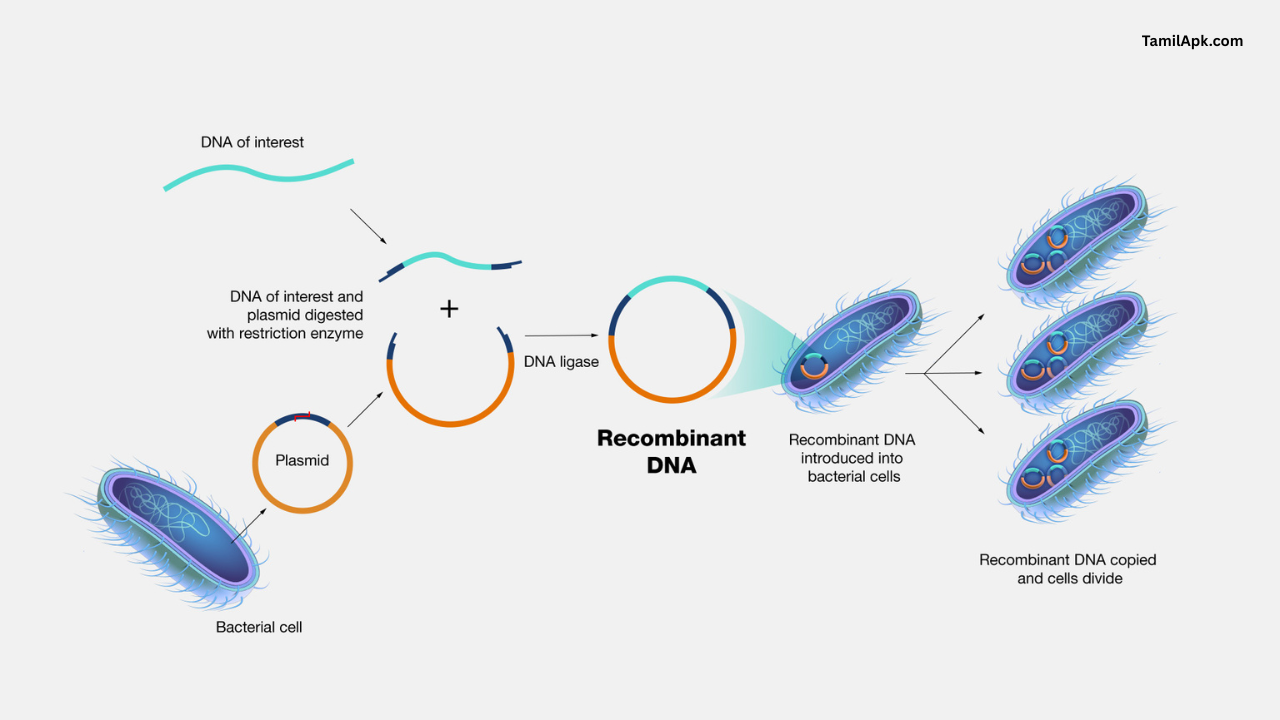
Step 1: Isolation
You take from the DNA from the source (e.g. the human cell) as well as the vector (e.g. the Bacterial or plasmid).
Step 2: Fragmentation (Cutting)
The identical Restriction Enzyme to remove both human DNA as well as the plasmid.
- Important Concept: Since youve used the exact enzyme the two have identical “sticky ends” (like Velcro) that are perfectly compatible.
Step 3: Ligation (Joining)
Mix the separated DNA as well as the plasmid. The ends that are sticky meet each the other. Add DNA Ligase which permanently bonds them to one another. Now you have Recombinant DNA.
Step 4: Transformation (Insertion)
It is your job to force the bacteria absorb the plasmid.
- The rapid heating and cooling of the bacteria to open their pores.
- Electroporation: The zapping of them by electricity it pushes the DNA within.
Step 5: Screening (Selection)
Certain bacteria wont take the virus. The ones that did need to be killed. bacteria that did not.
- The trick is that the plasmid is home to the Antibiotic Resistance Gene. It is grown in dish that is stocked of antibiotics (like Ampicillin). Only bacteria carrying the plasmid you have.
Step 6: Expression
The bacteria that survive are then put into huge fermentation tanks. They are able to read human genes (e.g. The gene that encodes Insulin) and begin extruding the protein.
The 2026 Frontier AI & Synthetic Biology
These are the places where textbooks have become outdated. Today we arent content to “find” genes; we create the genes.
1. AI Designed Proteins (De Novo Design)
Software such as AlphaFold 4 (and its successors) enable scientists to enter specific task (e.g. “I want protein that eats plastic”) and then the AI produces the DNA sequence needed to construct it. Then we print the DNA using lab.
2. Cell Free Systems
In the past it was necessary to have live cells in order to produce proteins. In 2026 cell free protein Synthesis (CFPS) is gaining momentum. We remove from cells the “machinery” (ribosomes) from cells and perform the reaction inside an in vitro. Its faster and easier.
3. “Digital to Biological” Converters
Scientists are now able to send an DNA sequence to an “Bio Foundry” (like 3D printer specifically designed for the biological). Foundry robots will make the plasmids and send the actual DNA into the laboratory in matter of days.
Applications in 2026
| Sector | Application | The 2026 Context |
| Medicine | Recombinant Insulin | The most famous success tale. The majority of insulin in the world today is produced by yeast or bacteria. |
| Medicine | Monoclonal Antibodies | Medicines that begin with ” mab” (e.g. Keytruda). These are immune system troops that are cloned by lab in order to combat cancer. |
| Vaccines | Subunit Vaccines | It is believed that the Hepatitis B vaccine as well as the HPV vaccines are produced with rDNA yeast. |
| Agriculture | Bt Crops | Cotton and Corn designed to make the pesticide they produce (harmless to human beings but toxic to insects and worms). |
| Environment | Bioremediation | “Super bacteria” engineered to clean off oil spills and reduce the heavy metals. |
| Gene Therapy | CRISPR Cas9 | The gene is fixed inside your body (e.g. fixing the gene inside your body (e.g. curing Sickle Cell Anemia). |
rDNA and. CRISPR: Whats the different?
Many people confuse them. we explore the fascinating world of the mind—breaking down psychology concepts into simple is distinction to make:
| Feature | Recombinant DNA (rDNA) | CRISPR Cas9 |
| Mechanism | “Cut and Paste” foreign DNA to host. | “Find and Replace” or “Delete” existing DNA. |
| Goal | The most common reason is to produce the product (Protein/Drug). | Most often it is to correct an inherited defect. |
| Precision | Low (Random inserts are common). | High (Targeted towards certain alphabet). |
| Source | Combining DNA from various species. | Edits the organisms genome. |
Our Opinion : The “Hard Truths” of the Industry
- The “Off Target” Nightmare is Real. The 2026 brochures for marketing claim 100percent accuracy however in reality biological systems can be complicated. In the process of inserting genes or modify their expression we can also alter the other genes that are crucial (insertional Mutagenesis). This is the reason why the FDA is not quick to accept gene therapies. “fixed” gene today could cause cancer in 10 years time after now.
- The Biomanufacturing Bottleneck. It is possible to design amazing cures yet we cant make them in timely manner. We are facing worldwide deficit in “bioreactor capacity” (the tanks which are used for the growth of the cells). If youre seeking the job of 2026 you dont have to just focus on the genetics field; you should learn about Bioprocess Engineering. This is where the opportunities exist.
- “Bio Hacking” is Dangerous. It is possible to find “DIY CRISPR Kits” for on sale on the internet. Beware of these kits. The chance of developing pathogenic microorganism or creating an allergic reaction that is severe in yourself is extremely high. Let the editing of genes to BSL 2 (Biosafety level 2) labs.
Final Checklist: How to Start in 2026
If youre professional or student looking to get into this field. You should learn Python: Biology is becoming data science. Learn how to study genes and sequences. Understand “GMP”: Good Manufacturing Practice.
This is the normative standard to make pharmaceuticals. Being aware of this will make you hireable. Keep your focus in “Downstream Processing”: Everyone would like to be part of the latest gene engineering (Upstream) however most of the cash is spent on cleaning the product (Downstream).